

Customer and partner sessions
Customer and partner sessions that end in shared next steps.
Executive roundtables, partner strategy sessions and joint innovation workshops, designed as a dialogue and not as a presentation.
Partnership Pathfinder
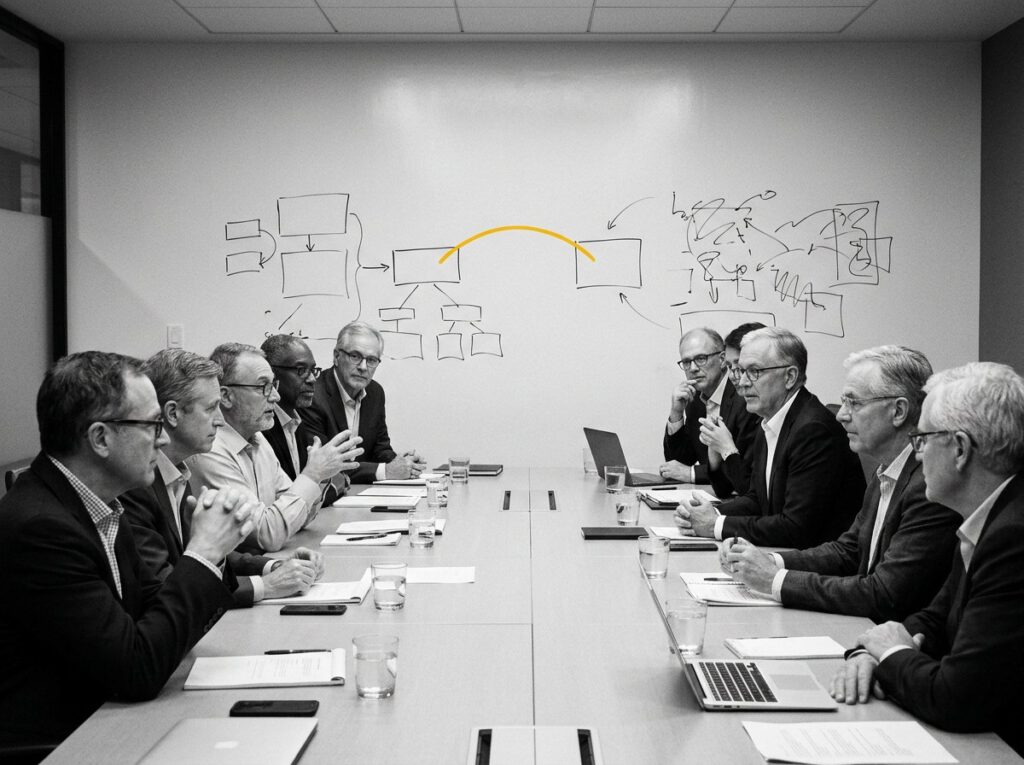
When a partner meeting becomes a sales pitch
Each side presents its slides, and nobody asks the hard question.
Both sides agree on everything in the room and nothing changes afterwards.
The people who could decide are in the room, but the format never asks them to.
A promising collaboration stays an idea because nobody owns the next step.
Your customers and partners see your business from the outside. A good session gives them the room to say what they see.
How I run a customer or partner session
Step 1
Agree on the purpose
We agree on what the session has to answer, for you and for your guests. Then I design the session around it.
Step 2
Facilitate the dialogue
I facilitate the session so both sides compare views and say what they need. The discussion is visible on the wall as it happens.
Step 3
Leave with next steps
The session ends with shared priorities and an owner for each next step, on both sides.
Formats: executive roundtables, partner strategy sessions, joint innovation workshops, assessments of a possible collaboration with a partner or customer.
Four formats, one principle
Executive roundtables
A small group of senior leaders from different companies talks about a challenge they share. You host the conversation. You do not lead it.
Partner strategy sessions
You and a partner work out where you go to market together, what each side brings, and who does what next.
Joint innovation workshops
Your team and your customer's team work on a real problem of the customer's, on the wall, together.
Collaboration assessments
Before you sign, both sides look at whether the fit is real. Better to find the gap in a workshop than in year two of a contract.
The principle is the same in all four. A dialogue, not a presentation, and shared next steps at the end.
Whose side am I on?
Both. My role is impartial, loyal to everyone in the room. Your guests can tell when a session is a sales pitch in disguise. They can also tell when it is not, and that is when they start to say what they think.
100+
Strategy sessions, executive roundtables and customer advisory boards across five continents
I started this work at Hewlett-Packard's Executive Briefing Center in Silicon Valley, with the company's most important customers.
Questions about customer and partner sessions
How long is a session?
Usually a full day, because the topic is important enough to need it. Depending on where your team stands, it can be shorter. I recommend not going under half a day. Cut it shorter and you lose the conversations you came for.
What do we take home?
First, shared priorities and next steps that both sides agreed on. After the session you receive a report with all the content and illustrations made during the day. More detailed reports are possible, and we agree on them up front.
What is an executive roundtable?
A facilitated conversation among senior leaders from several companies about a challenge they share. Guests leave with ideas from their peers. The host leaves knowing its customers better.
Can a roundtable run virtually?
Yes. During the Covid years I designed and ran global virtual executive roundtables with CISOs and IT security leaders for the Americas, Europe and Asia.
How is this different from a customer advisory board?
An advisory board is a standing group that meets again and again to advise you. A customer or partner session is a single event with one purpose. See customer advisory boards.
Who should come from our side?
The people who can decide on the next step. A session where only the account team sits across from the customer's leaders ends in goodwill and no owner.
Planning a session with a customer or partner?
See all four ways to work with me →
Other ways to work with me