

High-stakes decision meetings
Get the question right. Then decide it together.
I design and run strategy offsites and decision meetings that end with owners and next steps.
Decision Pathfinder
Where important meetings go wrong
The agenda is full, but nobody agreed which question the meeting has to answer.
A long slide deck, little discussion, and the real objections come after.
Competing priorities stay competing.
The meeting ends with "let's follow up".
The next meeting starts from the beginning.
Every meeting like this costs time you do not have, and the decision is still open.
Decisions teams bring to me
Which initiatives get funded next year, and which ones stop.
A target operating model after a merger or a reorganization.
An AI roadmap that technology and business both have to own.
A board meeting six weeks out, and a leadership team that still disagrees.
Technical on the surface, political underneath. The design is the same every time: one question, the right people, a visible discussion and a clear decision.
How I run a decision meeting
Don't let your team solve the wrong problem brilliantly. The work starts before the meeting.
Step 1
Agree on the question
Before the day, we agree on the real question and what a good answer looks like. We also agree who must be in the room.
Step 2
Work it out on the wall
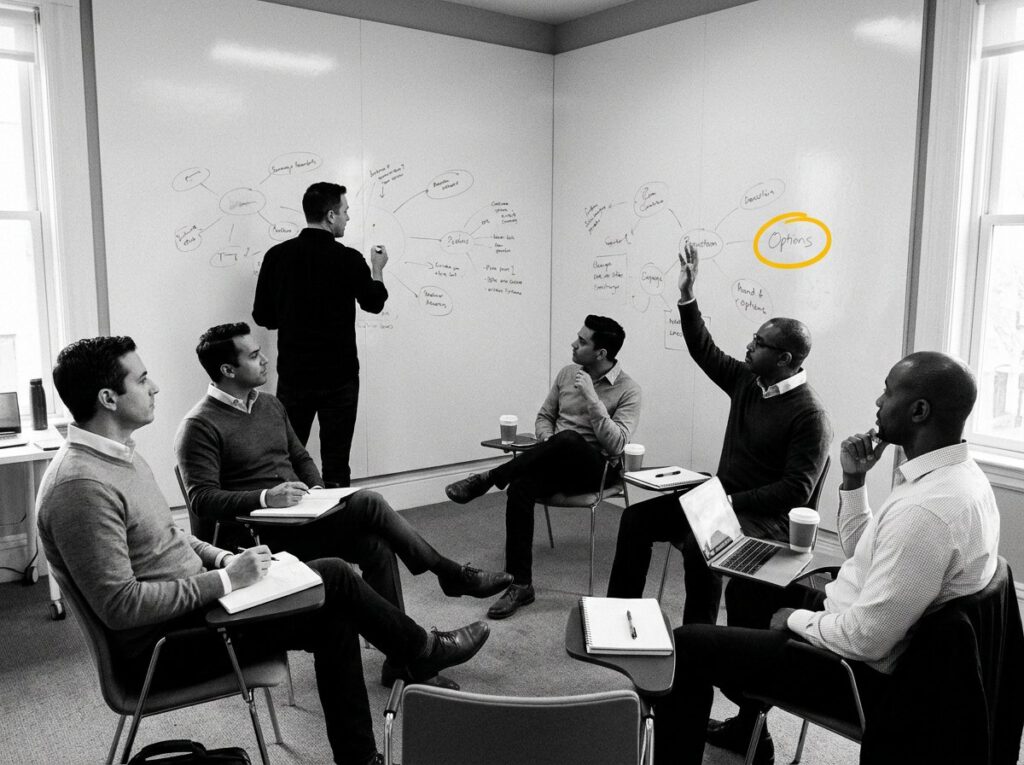
No endless slide decks. The team works on large walls while I draw the discussion. Different views show up early, while there is time to settle them.
Step 3
Decide and assign
The meeting ends with the decision stated clearly, an owner for each next step, and a date.
What the work looks like
Before the meeting
We talk about the question until it fits in one sentence. We agree what a good answer looks like and who must be in the room to make it and own it. Most of the value is created here. A meeting built on the wrong question cannot be saved on the day.
On the day
No slide marathon. The team works standing, at large walls, and I draw the discussion as it happens. Options and trade-offs are in front of everyone, so vague objections turn into specific choices.
At the end
The decision is said out loud and written on the wall. Every next step has an owner and a date. Nobody leaves with "let's follow up".
100+
Strategy engagements across 36 industries and five continents
"What we accomplished in one day with your facilitation would have taken us at least a year of discussions in our standard way of doing business."
Meeting attendee
Questions about decision meetings
How long is a session?
Usually a full day, because the topic is important enough to need it. Depending on where your team stands, it can be shorter. I recommend not going under half a day. Cut it shorter and you lose the conversations you came for.
What do we take home?
First, the decision itself, with an owner and a date for every next step. After the session you receive a report with all the content and illustrations made during the day. More detailed reports are possible, and we agree on them up front.
What is the difference between a strategy offsite and a decision meeting?
An offsite is a place and a date. A decision meeting is a design. Most offsites are planned around an agenda. I plan the day around the decision your team has to leave with. Your next offsite can be a decision meeting.
Who should be in the room?
Everyone who has to make the decision or carry it out, and nobody who is only there to watch. We decide this together before the day.
What if the team cannot agree on the day?
Then you leave knowing exactly where the disagreement is, what information is missing, and who brings it by when. That is a plan to decide, which is more than another round of "let's follow up" gives you.
Can you run it virtually?
Yes. Most of my work is in person, because the walls matter. Virtual sessions follow the same three steps.
Not sure this is a decision question and not a team question? See leadership team meetings.
Is there a decision on your calendar that keeps moving?
See all four ways to work with me →
Other ways to work with me