

Leadership team meetings
Build a leadership team that can disagree, decide and follow through.
Offsites and team meetings for senior teams with all the talent they need, and decisions that still do not stick.
Leadership Pathfinder
Does this sound familiar?
People defend their own area before the shared goal.
The real disagreement comes out after the meeting, not in it.
Decisions get made, then quietly reopened.
Nobody feels fully responsible for the follow-through.
Hard topics stay off the agenda because the conflict feels too risky.
None of this means the people are wrong. It is worth looking at together: what stops your team from disagreeing openly and owning its decisions?
When leaders call me
Most leadership teams do not call because something broke. They call because something is coming.
A new leadership team after a reorganization, a merger or a new CEO.
An offsite on the calendar, and an agenda you already know will not hold.
A strategy everyone signed, and three different versions of it in the hallway.
A transformation that depends on peers who have to commit, and stay committed when the room empties.
If one of these is on your desk, the team problem and the business problem are the same problem.
What we work on
We work on trust, how you handle disagreement, and who owns what. The team talks openly about all three, on the wall, where everyone can see it.
Then we turn it into practice. Shared priorities, clear ownership, and agreements on how you will decide in the future.
What you leave with
A team that says what it thinks in the meeting
Shared priorities and clear owners
Agreements the team made and will hold each other to
What happens in the room
We start with the work, not with an exercise. The team talks about a real topic that matters to the business. How it handles that topic tells us more than any questionnaire.
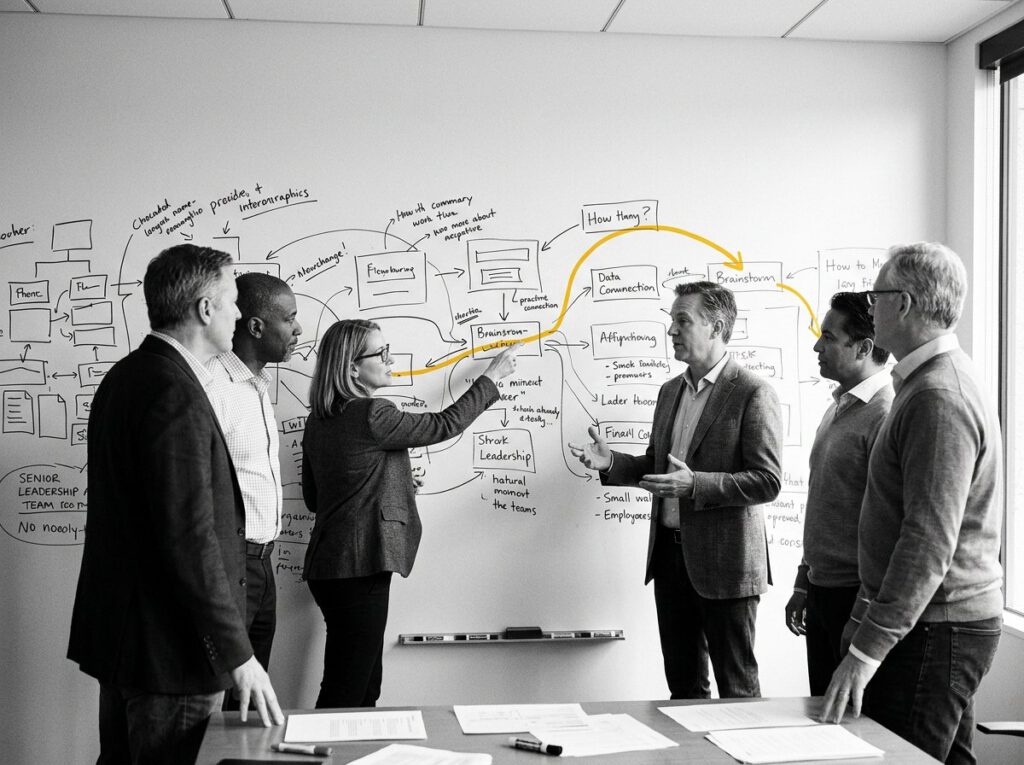
I draw the discussion on large walls while it happens. When two people disagree, the disagreement is on the wall where everyone can see it. It is easier to argue with a drawing than with a colleague.
Then we look at the pattern. Where did the team go quiet? Which topic did nobody want to touch? Who owns what, and who only thinks they do?
The last part is the one most offsites skip. The team agrees how it will decide from now on, what happens when someone disagrees after a decision, and how members hold each other to it. The team writes these agreements in its own words. That is why they hold.
How we start
Step 1
A first conversation
You tell me what is happening in your team. We see whether my approach fits.
Step 2
Find the blockers
Together we look at the team's strengths and at what holds it back.
Step 3
The session and the plan
A session designed for your team, and a plan with clear owners at the end.
100+
Strategy engagements across 36 industries
"It was a cathartic experience – you forced us to have the honest and truly relevant discussions we had actively avoided for a very long time."
Meeting attendee
Questions leadership teams ask
How long is a session?
Usually a full day, because the topic is important enough to need it. Depending on where your team stands, it can be shorter. I recommend not going under half a day. Cut it shorter and you lose the conversations you came for.
What do we take home?
First, a team that agrees, with the priorities and decisions it made together. After the session you receive a report with all the content and illustrations made during the day. More detailed reports are possible, and we agree on them up front.
Is this team building?
No. There are no trust games. We work on the topics and decisions your team has in front of it. Trust grows from doing hard work together, and doing it well.
What if the conflict in the team is already personal?
Then a structured setting matters even more. We agree the rules before the session, and I keep the discussion on the work and on behaviour, not on character. If the team is not ready for an open conversation yet, I will tell you in our first call.
Should the team lead be in the room?
Yes. A leadership team cannot change how it decides without the person who decides last. We talk before the day about the role you play in the session, because it is not the role you play in a normal meeting.
How is this different from a decision meeting?
A decision meeting answers one business question. A leadership team meeting works on how the team answers every question. Some teams need one, some need both. If you are not sure, start with the question that is on the table now. See decision meetings.